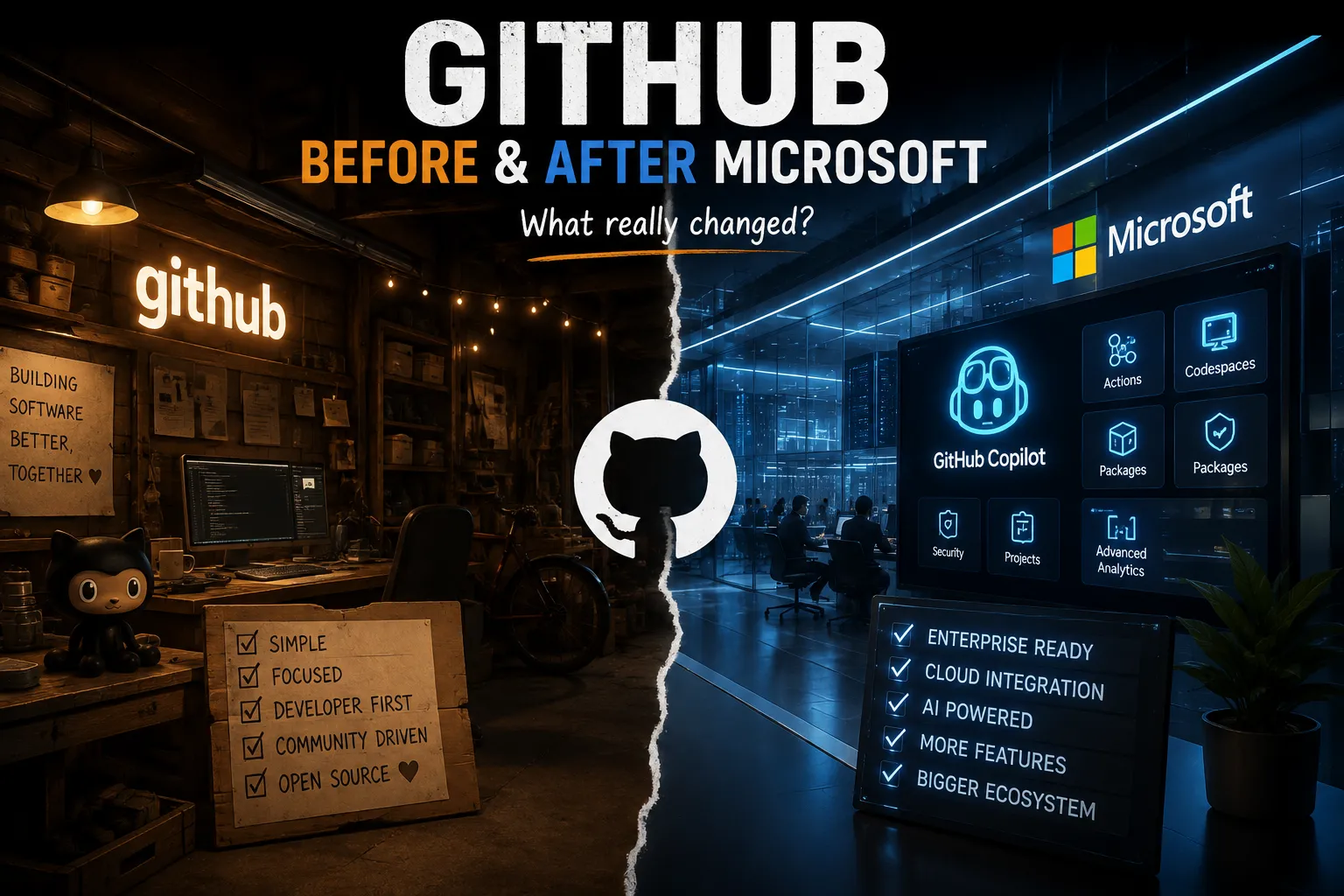
GitHub Before and After Microsoft: Did They Actually Ruin It?
In 2018, Microsoft announced that it was buying GitHub for $7.5 billion.
And for a few hours, you would've thought somebody had deleted the entire internet.
Developers were panicking.
“GitHub is dead.”
“Open source is finished.”
“Time to move to GitLab.”
“Microsoft is going to put Windows Update inside git push.”
Okay, maybe nobody said that last one.
But they probably thought it.
Microsoft announced the deal on June 4, 2018, and officially completed the acquisition in October.
And honestly, the panic wasn't completely ridiculous.
This was Microsoft.
A company that historically didn't exactly have the warmest relationship with open-source software.
So when Microsoft suddenly walked into the biggest open-source party on the internet and basically said:
Hey guys, we own the building now.
People got a little nervous.
Fair enough.

But it's been almost eight years now.
So instead of screaming about the death of open source, it's probably time to ask a much better question:
What actually happened to GitHub after Microsoft bought it?
---
GitHub Before Microsoft
Before Microsoft showed up with its giant corporate wallet, GitHub felt different.
Not necessarily better in every possible way.
Just... simpler.
GitHub was basically the cool neighborhood café for developers.
You uploaded code.
You cloned repositories.
You opened issues.
You sent pull requests.
You argued with somebody for three days about whether a variable should be called userData or user_data.
You know.
Programming.

There weren't fifty different products trying to become part of your development workflow.
No Copilot sitting next to you trying to finish your function before you even knew what you were writing.
No Codespaces.
No giant CI/CD platform living directly inside every repository.
GitHub was mainly about one thing:
hosting Git repositories and collaborating on code.
And it was really good at that.
But Old GitHub Wasn't Perfect Either
People sometimes remember pre-Microsoft GitHub like it was some magical developer paradise.
It wasn't.
Private development was much less friendly for free users than it is today.
A lot of features we now consider completely normal either didn't exist or required paid plans.
GitLab and Bitbucket were also pushing hard, especially when it came to private repositories and integrated development tools.
So yes, old GitHub was clean.
It was focused.
It had that classic developer-tool feeling.
But it also had limitations that everyone conveniently forgets when nostalgia kicks in.
---
Then Microsoft Appeared
In June 2018, Microsoft announced the $7.5 billion acquisition.
And developers reacted extremely normally.
Meaning:
not normally at all.
Part of the problem was Microsoft's reputation.
Modern Microsoft contributes heavily to open source.
But older developers remembered a very different company.
The same company whose former CEO Steve Ballmer once called Linux a “cancer.”
So naturally, some people imagined the worst possible future.
GitHub would become Azure-only.
Linux support would slowly disappear.
Visual Studio would somehow become mandatory.
Every repository would require a Microsoft account, an Xbox account and probably three system restarts.
None of that happened.
GitHub continued working with basically every language, operating system, editor and cloud platform people were already using.
And then something slightly annoying happened.
GitHub started getting... better.
Yeah.
I know.
We were supposed to hate Microsoft here.
Give it a minute.
---
Private Repositories Became Free
One of the biggest early changes after the acquisition came in January 2019.
GitHub started offering unlimited private repositories to free users.
Later, the restrictions around collaborators were relaxed too.
That was genuinely a big deal.
Students could keep coursework private.
Developers could build side projects without exposing everything to the entire internet.
Small teams could work together without immediately buying a subscription.
And most importantly, recruiters could no longer discover that horrible test repository you made at 3 AM six years ago.
Everybody wins.
Well...
GitHub probably lost a few small subscription payments.
Somehow, Microsoft survived.
---
GitHub Actions Showed Up
Then GitHub apparently asked:
Why should developers leave GitHub just to run CI/CD?
And GitHub Actions arrived.
Suddenly you could automate builds, tests, releases, deployments and pretty much anything else directly inside your repository.

Push some code.
Run the tests.
Build the application.
Build a Docker image.
Deploy it.
Realize you deployed the wrong environment variable.
Fix it.
Pretend nothing happened.
All without leaving GitHub.
This was one of the biggest changes to GitHub as a product.
Before Actions, GitHub was mostly where your code lived.
After Actions, GitHub increasingly became where your development workflow lived.
And this is where Microsoft's influence became easier to see.
Not necessarily in a bad way.
But Microsoft didn't spend $7.5 billion because Satya Nadella desperately needed somewhere to store his weekend JavaScript projects.
GitHub was becoming infrastructure.
---
Then Came Codespaces
Microsoft owns Visual Studio Code.
Microsoft owns GitHub.
So eventually somebody looked at both products and apparently said:
Why are these two things separate?
Enter GitHub Codespaces.

The idea is pretty simple.
Instead of spending half your morning installing dependencies, configuring environments and discovering that the project only works with Node 16.13.1 during a full moon, you can launch a ready-to-use development environment in the cloud.
Basically:
VS Code + GitHub + cloud computing.
From Microsoft.
The Microsoft developer ecosystem was slowly assembling itself like the Avengers.
Except everybody had a corporate badge.
Codespaces is genuinely useful, especially for onboarding developers, large teams and complicated development environments.
But it's also a perfect example of how GitHub changed.
Old GitHub:
Here's your repository.
Modern GitHub:
Here's your repository, development environment, automation platform, package registry, security scanner, AI programmer and probably your future mortgage provider.
Okay.
Maybe not the mortgage.
Yet.
---
And Then Microsoft Gave GitHub AI
Of course it did.
Because apparently no software product is legally allowed to exist in the 2020s without AI somewhere inside it.
GitHub Copilot appeared in 2021.

And unlike a lot of “AI-powered” buttons companies started throwing into everything, Copilot actually changed how a lot of developers write code.
It could suggest lines.
Functions.
Tests.
Documentation.
Boilerplate.
And occasionally code that makes you stare at the monitor and question every decision that brought you into software development.
Here's the part that's actually interesting:
Microsoft now had:
- GitHub
- Visual Studio Code
- Azure
- GitHub Copilot
That's a pretty serious chunk of a developer's daily workflow living inside one corporate ecosystem.
Convenient?
Absolutely.
Slightly terrifying?
Also absolutely.
---
So What Got Worse?
Okay.
Enough being nice to Microsoft.
There are definitely things about modern GitHub that feel worse.
GitHub Feels Heavier
Old GitHub felt focused.
Modern GitHub sometimes feels like somebody keeps adding another room to a house without checking the original blueprint.
Actions.
Projects.
Packages.
Codespaces.
Copilot.
Security.
Discussions.
Marketplace.
Enterprise features.
AI features.
More AI features.
And presumably, sooner or later, an AI feature designed specifically to help you discover all the other AI features.
Every individual feature has a reason to exist.
But together?
GitHub doesn't really feel like a small, focused developer tool anymore.
It's a platform.
A very large platform.
---
GitHub Feels More Corporate
This might be the biggest difference.
Old GitHub felt like a developer company that happened to become huge.
Modern GitHub sometimes feels like a huge company that happens to make tools for developers.
There's a difference.
The product is more polished.
The infrastructure is bigger.
The enterprise tooling is much more serious.
But some of that slightly weird developer culture feels less visible than it used to.
That's what happens when your cool developer platform gets purchased for $7.5 billion.
Eventually somebody from Enterprise Sales is going to enter the room.
---
Microsoft Is Everywhere
There's another concern that isn't just nostalgia.
GitHub has become incredibly important to modern software development.
A ridiculous amount of open-source development happens there.
Companies depend on it.
Open-source projects depend on it.
Developers build their professional identities around it.
And the entire platform belongs to one of the largest technology companies on Earth.
Even if Microsoft behaves perfectly, concentrating this much developer infrastructure under one corporation is worth thinking about.
Git itself is decentralized.
The culture around GitHub increasingly isn't.
There's a little irony there.
---
Old GitHub vs Modern GitHub
Here's probably the easiest way to see what happened.
GitHub used to be mostly a place where developers stored and collaborated on code.
Today, it's trying to become the place where basically the entire software development lifecycle happens.

GitHub Before Microsoft
- Simple
- Focused
- Developer-driven
- Excellent Git hosting
- Strong open-source community
- Fewer built-in tools
- More restrictions around private development
- That old-school developer-platform feeling
GitHub After Microsoft
- Free private repositories
- GitHub Actions
- Codespaces
- GitHub Copilot
- Better security tooling
- Better enterprise support
- Much larger ecosystem
- More complicated
- More corporate
- Much more Microsoft
Basically, GitHub went from:
Put your code here.
to:
Please conduct your entire software engineering career inside this browser tab.
---
So... Did Microsoft Actually Destroy GitHub?
No.
Sorry.
That would've made this article much easier.
Microsoft did not destroy GitHub.
If we're judging the acquisition based purely on the actual product developers use today, GitHub gained a lot.
Private development became much more accessible.
GitHub Actions turned it into a serious automation platform.
Codespaces made cloud development environments easier.
Copilot created a completely new category of AI-assisted development.
Security tools improved.
Enterprise tooling improved.
The platform became useful for far more than simply storing Git repositories.
Microsoft didn't walk into GitHub and start deleting Linux repositories while laughing maniacally.
Which, based on some reactions in 2018, was apparently what people expected.
---
But Microsoft Definitely Changed GitHub
This is probably the more accurate criticism.
Microsoft didn't destroy GitHub.
It corporatized GitHub.
GitHub used to feel primarily like a home for code.
Now it increasingly feels like Microsoft wants GitHub to become the operating system for software development.
Write your code there.
Review it there.
Test it there.
Deploy it there.
Run your development environment there.
Scan your security vulnerabilities there.
Ask AI to write half your code there.
And preferably connect a few Azure services while you're at it.
Convenient.
Very convenient.
Almost suspiciously convenient.
Microsoft has basically spent the last few years building a very comfortable developer hotel.
The rooms are nice.
The Wi-Fi is good.
Breakfast is included.
You just occasionally remember that Microsoft owns the building.
---
Was Selling GitHub to Microsoft a Mistake?
If you asked a lot of developers in 2018, they would've said yes immediately.
Almost eight years later?
It's much harder to argue that Microsoft ruined the platform.
GitHub is significantly more capable today.
It's easier for individual developers to use.
It's better for teams.
Its automation tooling is excellent.
Its ecosystem is huge.
And Microsoft mostly resisted turning it into some bizarre Windows-and-Azure-only platform.
So...
credit where credit is due.
Unfortunately.
But something was lost too.
GitHub became bigger.
Heavier.
More complicated.
And definitely more corporate.
It went from feeling like the world's biggest developer clubhouse to feeling like the world's biggest developer office building.
There are security guards downstairs.
There's an enterprise sales department on the seventh floor.
Copilot is sitting next to you.
Azure is probably somewhere in the basement.
And Microsoft technically owns the whole thing.
But honestly?
Forget it.
It's not that bad.
We complained.
We threatened to move to GitLab.
We made jokes about Microsoft destroying open source.
And then the next morning we opened GitHub and pushed our code exactly where we always did.
Almost eight years later, most of us are still there.
So maybe Microsoft didn't destroy GitHub after all.
They just bought our favorite developer garage, renovated it into a giant corporate headquarters, installed a bunch of useful stuff we secretly like...
and somehow convinced us to keep coming back every day.
Comments & rating
Share your experience or reply to an existing discussion.
4 comments