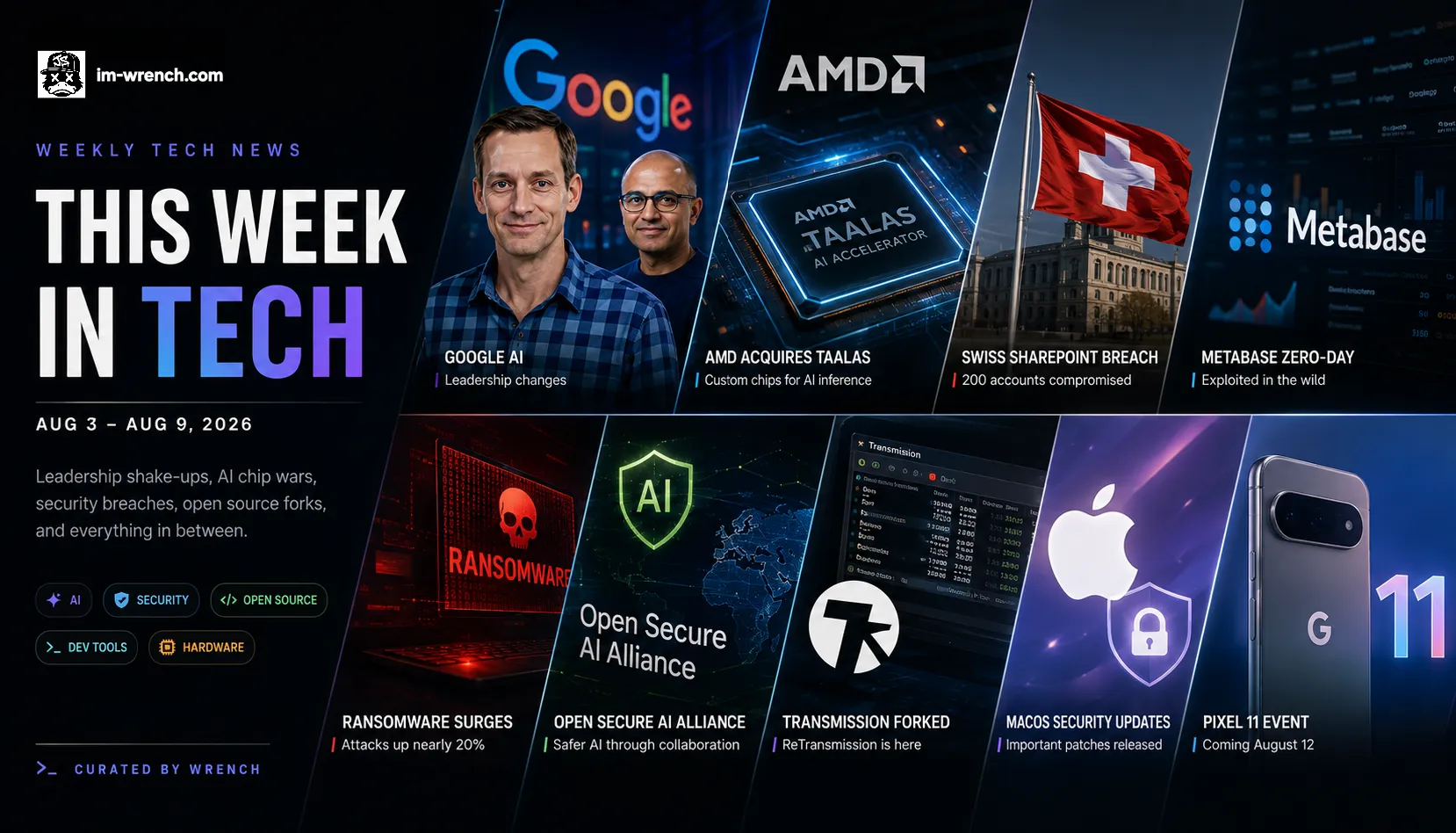
What Happened in Tech This Week?
August 3–9, 2026
If you only looked at the big tech headlines this week, you could probably get the impression that everything was about the next big breakthrough.
It wasn't.
This week was much more interesting than that.
Google reshuffled the leadership of DeepMind while Jeff Dean left after nearly 27 years to build something new with several longtime Google researchers. AMD agreed to acquire Taalas, a company taking a very different approach to AI inference hardware. Hackers broke into Swiss government SharePoint infrastructure. A critical Metabase zero-day was exploited in the wild. Ransomware attacks jumped again. Transmission got forked. And Apple shipped security fixes for serious macOS issues.
So instead of another week of shiny product announcements, this one was mostly about the stuff underneath technology.
Servers.
Chips.
Databases.
Security.
Open source.
And the people building all of it.
Let's get into it.

Google Just Shook Up Its AI Leadership
This was probably the biggest tech story of the week.
Google announced major changes inside Google DeepMind. Demis Hassabis is moving away from the day-to-day CEO role and will become Chair of Google DeepMind and Chief Scientist at Alphabet, while Koray Kavukcuoglu takes on a much larger operational role. Jeff Dean is also leaving Google after nearly 27 years, alongside Sanjay Ghemawat, Oriol Vinyals and Quoc Le, to build Discovery Loop, a new company focused on scientific and engineering research.
Google is also backing the new company.
And honestly, that's the part that caught my attention.
Jeff Dean isn't some random executive who decided to start a company after getting bored. He has been one of the people behind the infrastructure that made Google work at massive scale.
So when someone like that leaves after almost three decades, you pay attention.
I don't think this automatically means Google is falling apart. It does, however, show that Google is changing how it wants to operate.
Hassabis gets more room to focus on long-term science and strategy. Koray gets more responsibility for running the organization and pushing products forward. Dean gets to try something completely different.
That separation between “think about the next ten years” and “ship something this year” actually makes a lot of sense.
The interesting question is whether Google can keep its research culture strong while moving faster.
We'll see.
AMD Bought a Chip Startup With a Very Different Idea
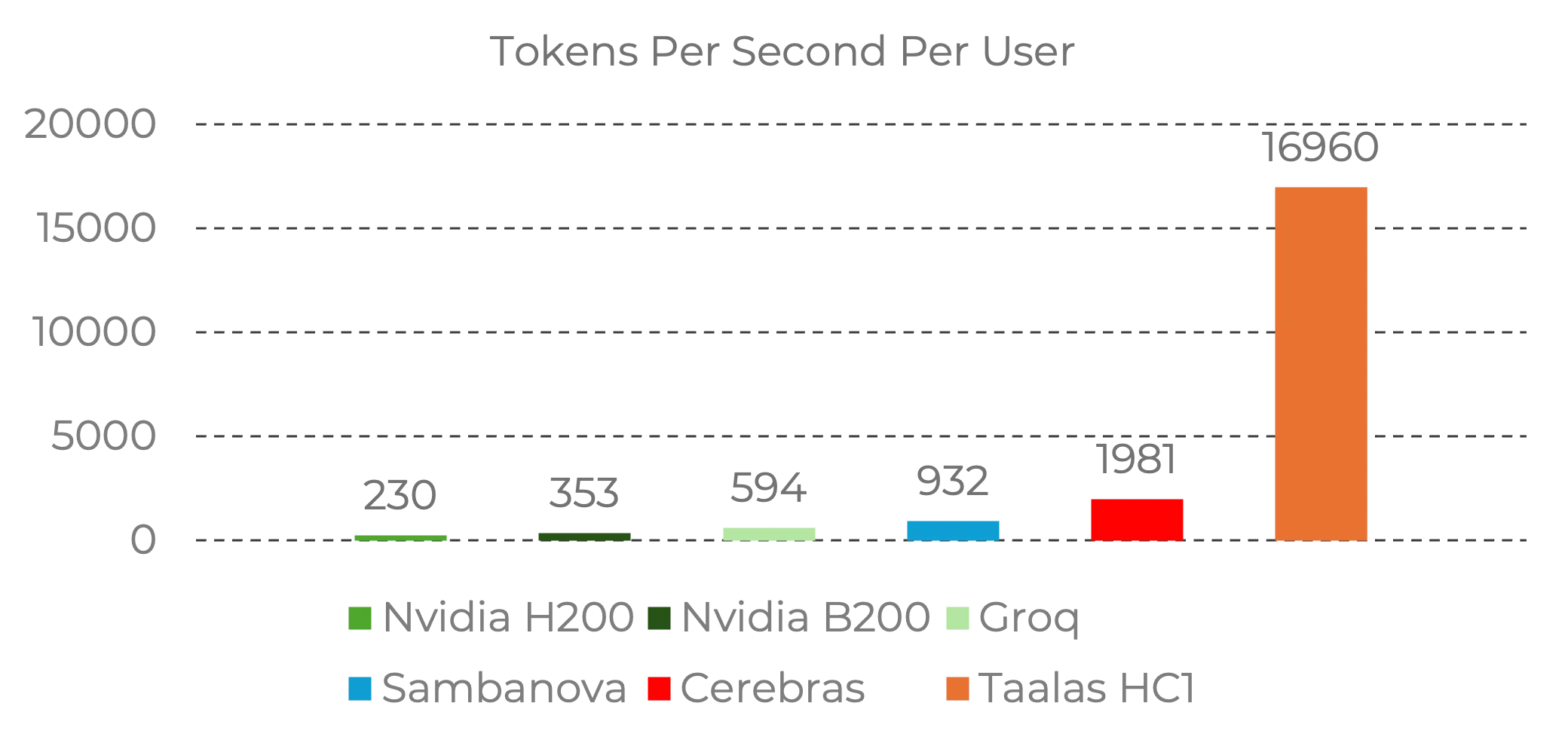
AMD agreed to acquire Taalas, a Toronto-based startup focused on specialized silicon for AI inference.
The important word here is specialized.
A normal GPU is designed to handle a huge range of workloads. Taalas takes a much narrower approach: build hardware around the workload itself and reduce some of the memory and compute bottlenecks that general-purpose accelerators have to deal with.
That can make inference dramatically faster and more efficient.
Of course, there's a catch.
The more specialized the hardware becomes, the less flexible it becomes.
That's not necessarily a problem when you're running the same kind of workload millions of times inside a data center.
And that's probably why AMD is interested.
The chip competition isn't just about who makes the fastest GPU anymore.
It's becoming a fight over the entire stack.
CPU.
GPU.
Networking.
Memory.
Software.
And now, increasingly, custom silicon.
AMD says it plans to integrate Taalas' technology into its accelerator roadmap and combine it with AMD Instinct GPUs.
That's a pretty serious bet on the idea that future AI infrastructure won't be built around one type of processor doing everything.

Hackers Got Into Swiss Government SharePoint Servers
This one is considerably less fun.
The Swiss government confirmed that attackers gained unauthorized access to SharePoint servers operated by its federal IT office.
Suspicious activity was detected on July 28, and by July 31 investigators had confirmed unauthorized access involving roughly 200 accounts.
The government said the incident involved SharePoint infrastructure and that attackers may have exploited recently patched vulnerabilities.
The interesting part isn't really SharePoint itself.
It's the reminder that running infrastructure yourself doesn't magically make it secure.
If anything, on-premise infrastructure gives you more responsibilities.
You have to patch it.
Monitor it.
Back it up.
Restrict access.
Watch the logs.
And make sure the thing you exposed to the internet doesn't have a giant hole in it.
Because an attacker doesn't care whether your server is in AWS, Azure, a government data center or sitting in a rack somewhere in your office.
If there's an exploitable service listening on the internet, that's what matters.
A Metabase Zero-Day Was Used to Steal Data
This one matters a lot more if you run your own analytics infrastructure.
A critical SQL injection vulnerability in Metabase was exploited as a zero-day. Metabase says the flaw can allow an attacker to gain administrative access to a vulnerable instance and potentially reach data and credentials stored through connected databases.
Framework and Tally were among the organizations that disclosed exposure related to the attacks.
And this is exactly why “it's just a dashboard” is a dangerous way to think about analytics software.
Your Metabase instance probably isn't sitting there with a cute little database full of fake numbers.
It's connected to something.
Customer data.
Orders.
Internal metrics.
User accounts.
Maybe production.
Which means the dashboard itself becomes part of your security boundary.
This is one of those boring engineering rules that becomes extremely interesting when someone breaks it:
Every service connected to your database is part of your database's attack surface.
It doesn't matter if the service is open source. It doesn't matter if it's popular. If it can reach your data, you need to treat it like it matters.
And if you're running a self-hosted Metabase instance, this is one of those weeks where “I'll update it later” is not a particularly good plan.
Ransomware Had Another Bad Month
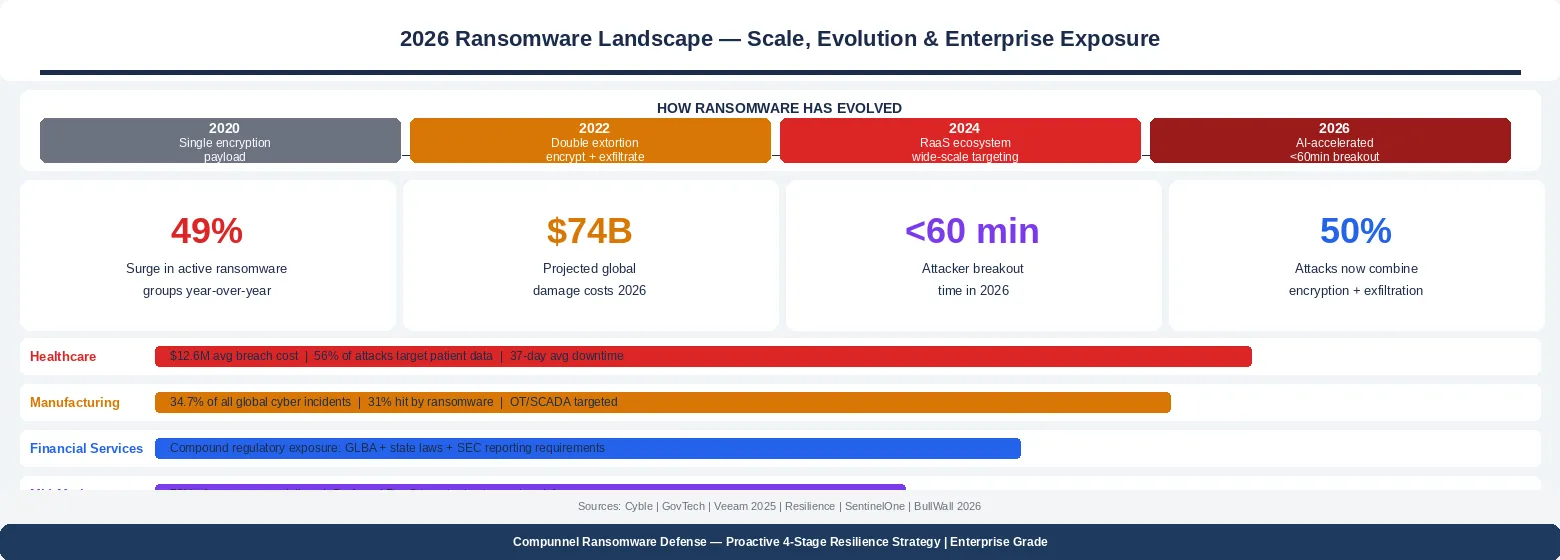
According to Comparitech's July 2026 ransomware roundup, the number of recorded ransomware attacks jumped from 668 in June to 799 in July.
That's a 19 percent increase, or almost 26 attacks per day.
And here's the part I find interesting.
While the tech industry spends most of its time talking about new platforms, new chips and whatever the current buzzword happens to be, ransomware is still making money with a lot of extremely ordinary techniques.
Unpatched software.
Stolen credentials.
Exposed remote access.
Social engineering.
Old vulnerabilities.
You don't always need some genius-level exploit chain.
Sometimes you just need one forgotten server.
That's why security isn't really a “security team problem.”
It's an engineering problem.
A deployment problem.
A backup problem.
A password problem.
And sometimes, unfortunately, a “somebody left this service exposed for six months” problem.
The Open Secure AI Alliance Is Moving
NVIDIA and other technology companies formed the Open Secure AI Alliance to build and share open tools and practices around AI security.
This week, the group put forward its SAFE guidelines, which include proposals for collecting and analyzing AI incidents and near misses, informing affected parties, and identifying recurring security problems.
The idea is pretty straightforward.
If one company discovers a dangerous security problem, the useful information shouldn't stay locked inside that company.
Security gets expensive when everyone learns the same lesson separately.
If company A gets attacked, spends months figuring out what happened, and company B has to repeat the whole process six months later, nobody wins except the attacker.
The interesting part will be whether these proposals become things developers actually use or just another collection of documents that gets mentioned at conferences and forgotten afterward.
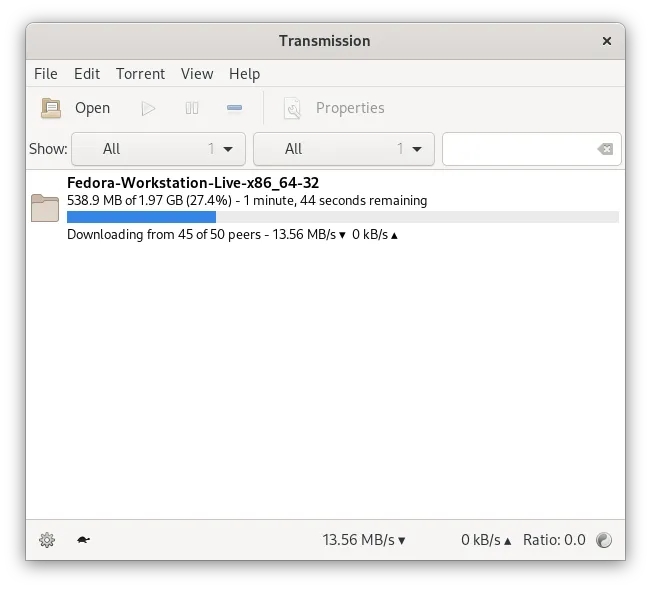
Transmission Got Forked
Okay, now we're back in proper open-source territory.
Transmission, one of the most recognizable BitTorrent clients in the Linux world, has been forked into a project called ReTransmission.
The split follows a longstanding disagreement among maintainers over the project's governance and whether more maintainers should be added.
And honestly?
This is peak open source.
Someone says:
“We should do it this way.”
Someone else says:
“No.”
Then eventually:
git forkAnd suddenly there are two projects.
😂
But that's also one of the best things about open source.
A fork isn't automatically a failure.
Sometimes it dies quietly after three months.
Sometimes it becomes the version everybody uses.
Sometimes the original project and the fork both survive because they serve different people.
The code doesn't belong to one person.
The community can disagree.
And when the disagreement gets big enough, somebody can just take the code and keep going.
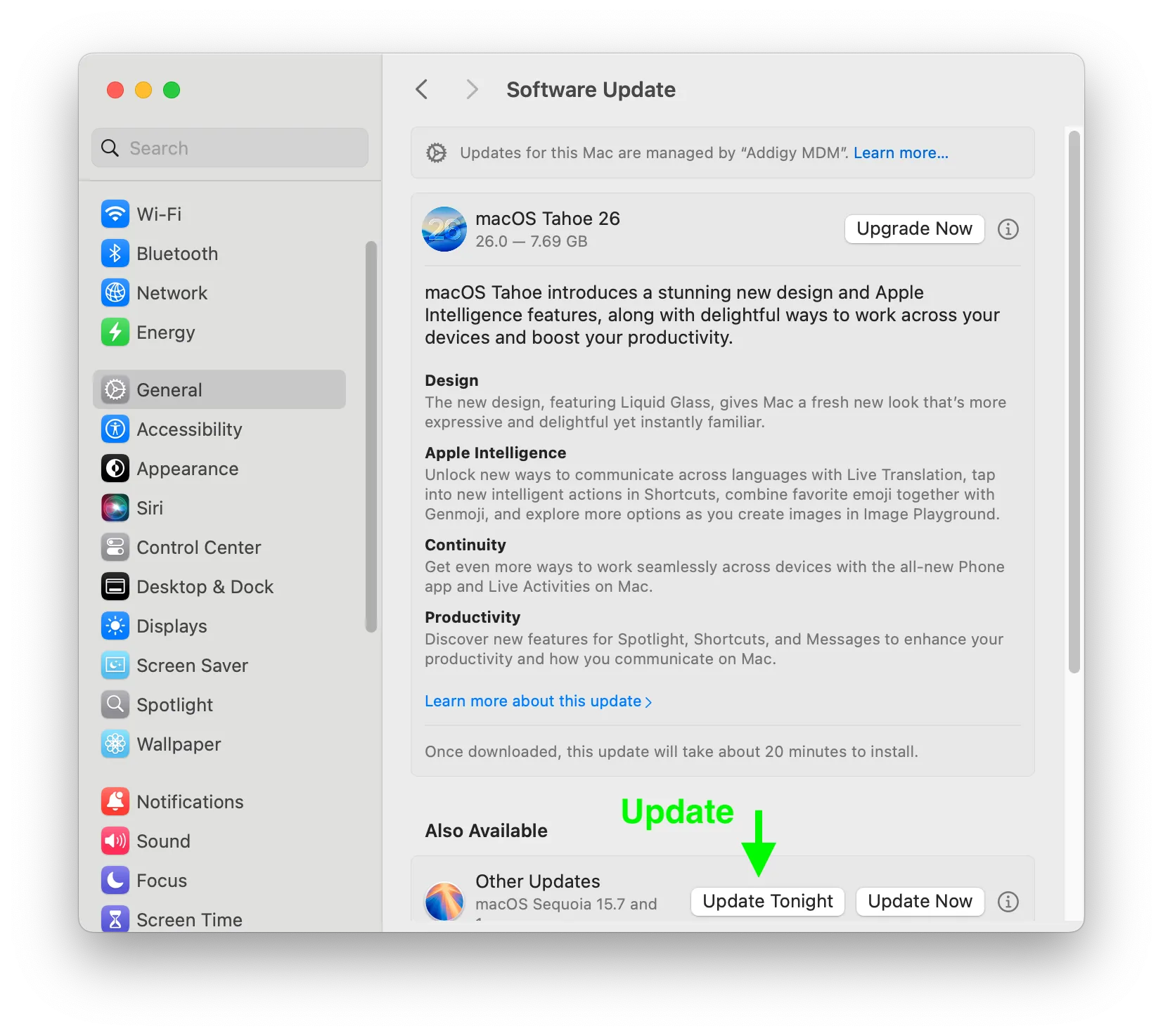
Apple Had a Pretty Busy Security Week
Apple also had to deal with a number of security issues this week.
Recent macOS updates for Tahoe, Sequoia and Sonoma include fixes for serious Screen Sharing vulnerabilities, including a flaw that could allow an attacker on the network to authenticate to Screen Sharing without valid credentials.
This is one of those stories that usually gets buried under product news.
But it probably shouldn't.
Screen sharing is one of those features people enable once and then completely forget about.
Anything that can remotely interact with your desktop deserves a little more attention than it usually gets.
Apple also faced attention around WebKit privacy issues affecting users of iCloud Private Relay.
The broader lesson is simple:
Privacy features are still software.
And software still has bugs.
That doesn't make the whole privacy system useless.
It just means “privacy” isn't a magic checkbox you turn on once and forget about forever.
What About Pixel 11?
Google has announced its Made by Google event for August 12, 2026, where the next generation of Pixel hardware is expected to be unveiled.

What I Actually Took From This Week
If I had to summarize this week, I wouldn't say it was about AI.
I wouldn't say it was about phones.
And I definitely wouldn't say it was about one giant new product.
It was about infrastructure.
Google is changing the people responsible for building its future.
AMD is betting on more specialized hardware.
Governments are still getting hit through enterprise software.
A dashboard can become an entry point into production data.
Ransomware is still growing.
Open-source projects are still splitting, evolving and surviving on their own terms.
And operating systems are still being patched because, well...
software is software.
We usually think of technology as the stuff we can see.
The phone.
The app.
The website.
The laptop.
But most of the interesting stuff is underneath.
Servers.
Databases.
Networks.
Compilers.
Repositories.
Packages.
Security patches.
And some developer sitting at 3 AM trying to figure out why production suddenly decided to stop behaving.
Honestly?
That's the part I find interesting.
---
Sources
Comments & rating
Share your experience or reply to an existing discussion.
1 comments